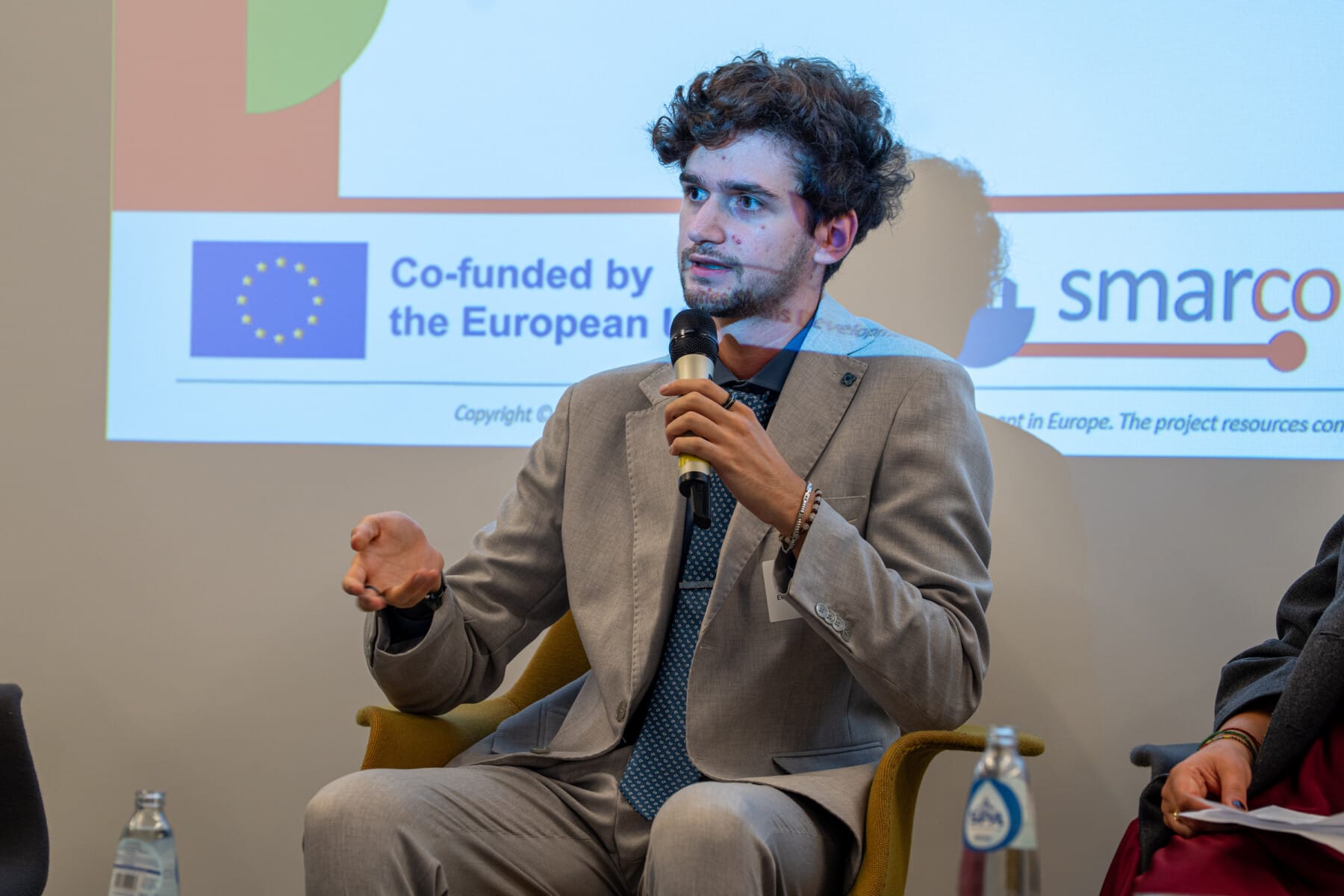
At the international conference Teaching Practices, Practicing Architecture | Architecture Pop-up Lab Exchange (APLE), held on 26-27 March 2026 at the University of Sarajevo, researchers Mohammed Eledeisy and Quan Zhu from HU University of Applied Sciences Utrecht (HU) presented their work on innovative educational and research practices as part of the European project Smart Communities Skills Development in Europe (SMARCO).
The APLE conference brought together researchers, designers, and educators from across Europe around a central question: how can architecture and urban design education respond more effectively to complex societal challenges such as digitalisation, sustainability, and urban resilience? The programme focused on the interplay between teaching and practising architecture, exploring how learning, research, and professional action can reinforce one another within contemporary design and engineering. It was a focus that aligns closely with the aims of SMARCO.
Addressing the skills gap for smart city engineers and planners
Eledeisy and Zhu presented their paper “Smart City Engineers and Planners: A Methodological Framework for Skills Gap Analysis in Europe”, written together with Steven Haveman, Beverly Pasian, and Pascal Ravesteijn. The paper sets out a methodological approach to analysing the skills needed in smart communities, showing how education, research, and professional practice can be connected through a shared, participatory model.
Central to the work was the development of new professional profiles, such as the Smart Community Resilience Engineer and the Resilient Solutions Planner/Procurer. These profiles reflect a growing demand for professionals who combine technical expertise with skills in collaboration, sustainability, digital technologies, and societal engagement. HU played a leading role in developing the underlying methodology, underlining its coordinating role and expertise within international consortia.
From research to educational innovation
A key theme of the presentation was how research outcomes can feed directly into educational development. Within SMARCO, this methodology is used to analyse existing study programmes, identify skills gaps, and translate those insights into new curricula as well as upskilling and reskilling pathways, closely mirroring HU’s mission to connect practice-oriented research with relevant, future-proof education.
The conference also opened up dialogue with other European institutions, generating valuable feedback and cross-fertilisation. It became clear that HU’s approach is seen as a strong example of how universities of applied sciences can contribute to major societal transitions by working together with governments, businesses, and citizens.