SMARCO Learning Programmes
– Building Skills for Smart Communities
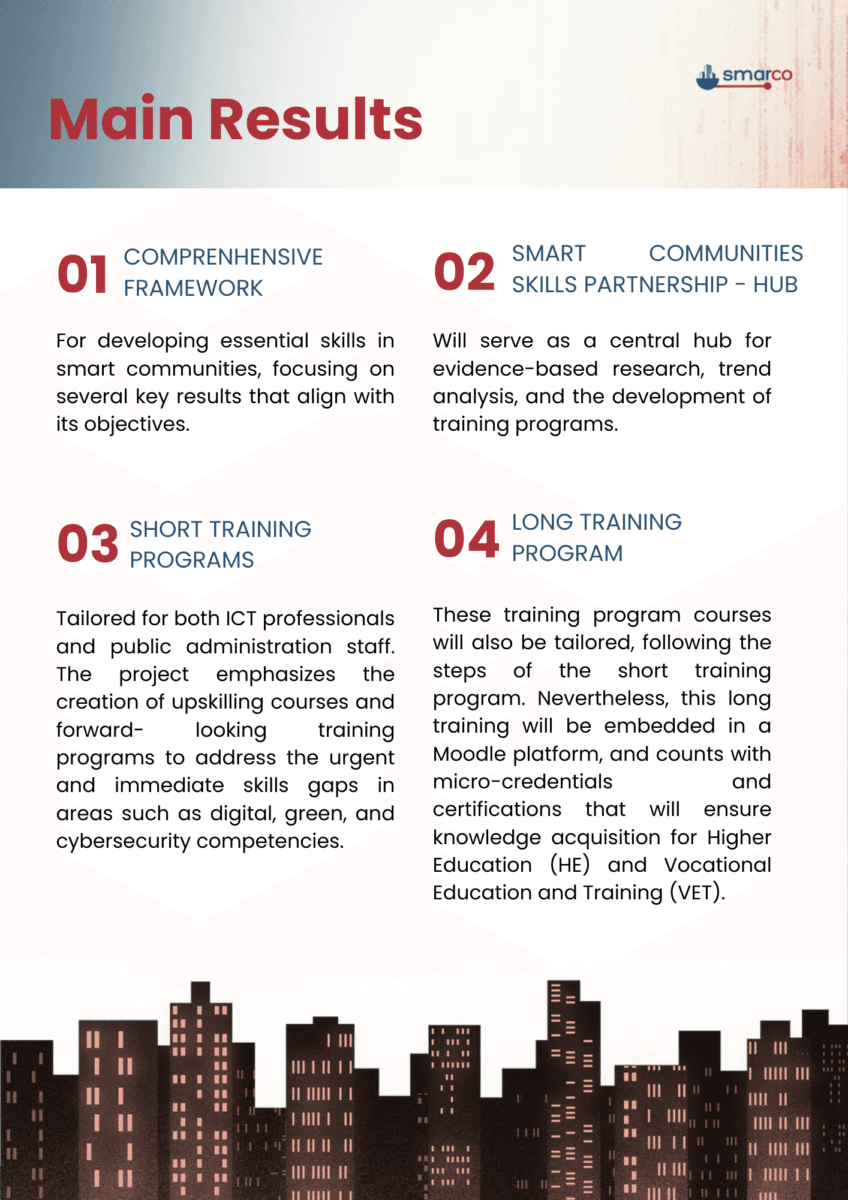
The SMARCO Learning Programmes prepare Smart Community Resilience Engineers and Smart Community Resilient-solutions Planners/Procurers to meet the challenges of tomorrow. Offering flexible learning opportunities and practical resources, these programmes help participants develop the knowledge and skills needed to drive innovation and resilience for a sustainable digital future.
Pilot Phase:
Building Programmes Together
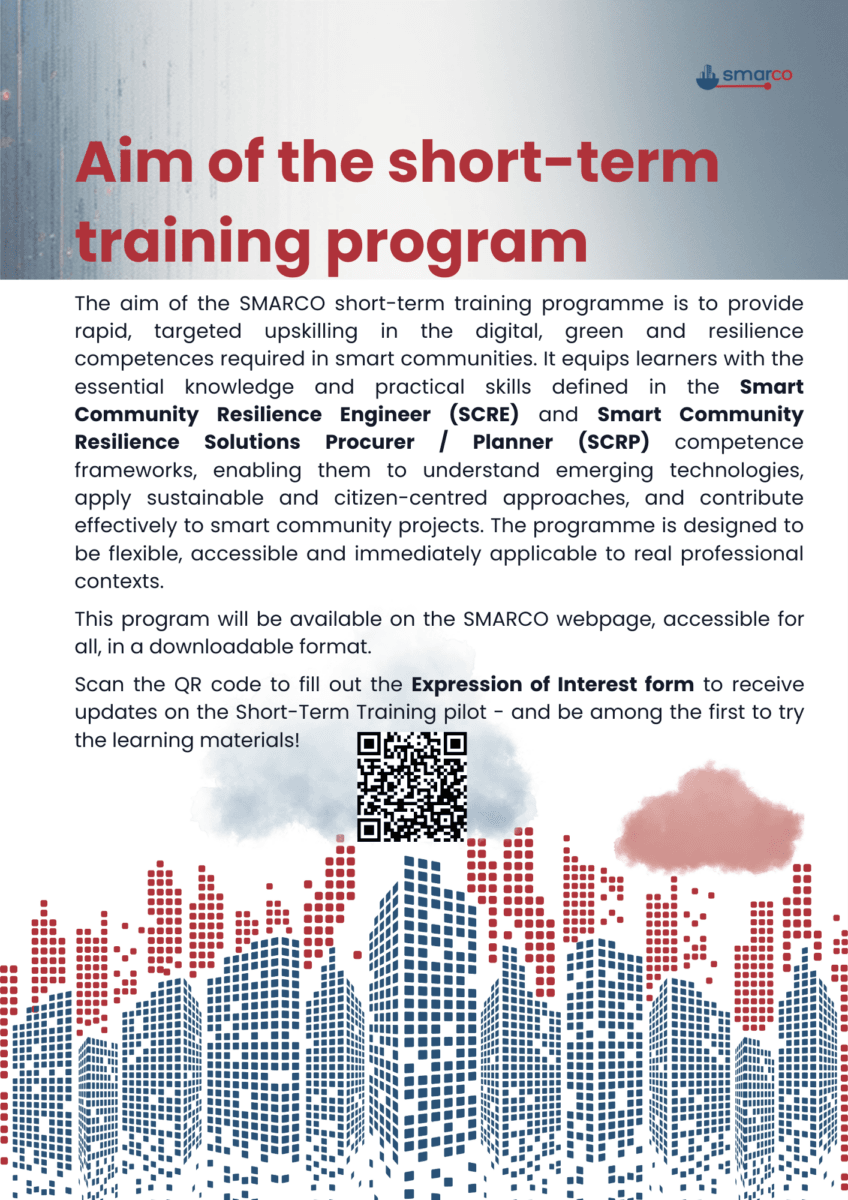
The piloting phase gives participants early access to SMARCO’s short-term courses, allowing them to explore new learning approaches in practical, real-world settings.
Far beyond a simple trial, this stage is a collaborative process where participants contribute directly to the evolution of the programmes. Through their insights and feedback, the courses are refined to ensure they are relevant, user-friendly, and tailored to the demands of emerging professional roles and the shifting needs of industry.


Be Part of the Change – Build the Skills for Tomorrow’s Resilient Communities
The SMARCO short-term courses are designed to close urgent skills gaps in smart communities. They target two emerging roles: the Smart Community Resilience Engineer, who develops digital and sustainable solutions, and the Smart Community Resilient-Solutions Procurer/Planner, who leads strategic planning and procurement for resilient infrastructures.
Combining practical knowledge with competence-based outcomes, the courses cover digital innovation, collaborative robotics, sustainability, data analytics, and smart city technologies. Flexible and adaptable, they equip professionals, educators, and students with future-ready skills aligned to European standards and industry needs.
Our Short-Term Courses
Choosing one of these short-term courses means embarking on a structured learning journey designed to upskill professionals currently working in, or aspiring to join, the smart communities and digital transformation sectors.
Each program builds your competencies step by step: starting with the foundational concepts that underpin today’s smart communities and progressively exploring the technologies, methodologies, and strategic tools needed to design, manage, and enhance resilient urban systems.
Rather than addressing topics in isolation, you will follow a coherent and purposeful learning path. You’ll begin with essential principles, advance to understanding the operation of smart infrastructures, develop skills to secure and analyze complex urban systems, and ultimately learn to apply your knowledge to create sustainable, future-oriented solutions.
Below, the modules are presented in the recommended sequence, each with a brief description. This structure provides a clear view of how your skills will evolve and helps you decide whether the program aligns with your professional development goals.
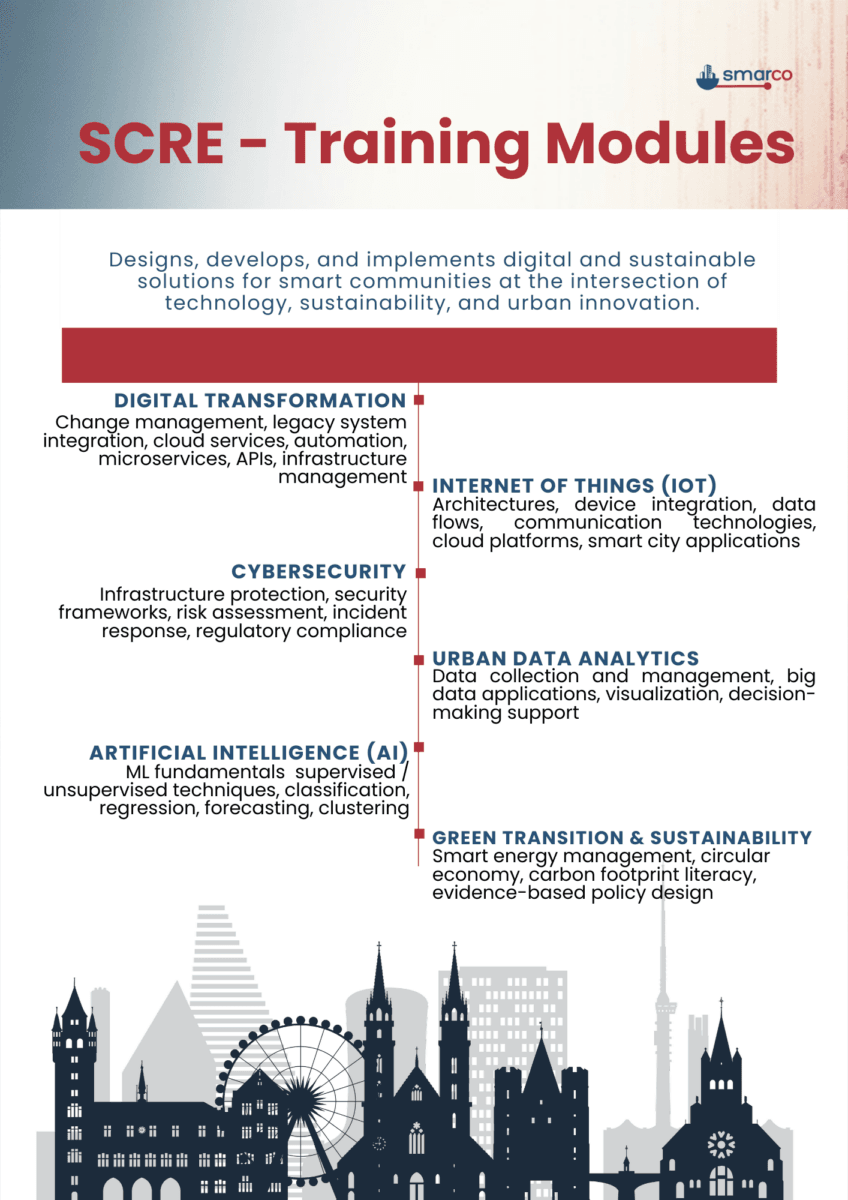
Smart Community Resilience Engineer – SCRE
Digital Transformation
Strategies and tools for leading digital change: legacy system integration, selection and management of cloud services, automation, microservices, APIs, and management of digital infrastructures in public and private organizations;
Internet of Things
IoT architectures, device integration, data flows in smart environments, main communication technologies, cloud IoT platforms, and meaningful IoT applications for smart cities;
Cybersecurity
Fundamentals of protecting smart community infrastructures: implementing security frameworks, cryptographic solutions, risk assessment, incident response systems, and compliance with cybersecurity regulations;
UNIT 1: Cyber Risk Assessment In Smart Communities – an Introduction
UNIT 2: Cryptography Fundamentals for Smart Community Engineers
Urban Data Analytics
Techniques for collecting, securely managing, and analyzing urban data: data analytics, big data applications, tools and visualization techniques, outlier detection, algorithmic accountability, and supporting decision-making for urban governance;
Artificial Intelligence
Fundamentals of AI and machine learning, supervised and unsupervised techniques, algorithms for classification, regression, forecasting, and clustering in smart city contexts, including automation and predictive analytics for smart services;
Green Transition & Sustainability
Managing smart energy sources, planning circular economy strategies, carbon emissions and footprint literacy, analysing sustainability challenges (environmental, social, economic), designing evidence-based sustainability policies, and monitoring organizational sustainability performance.
Introduction
UNIT 1: Foundations of Smart, Sustainable, and Green Communities
UNIT 2: The European Perspective: Green and Digital Transitions
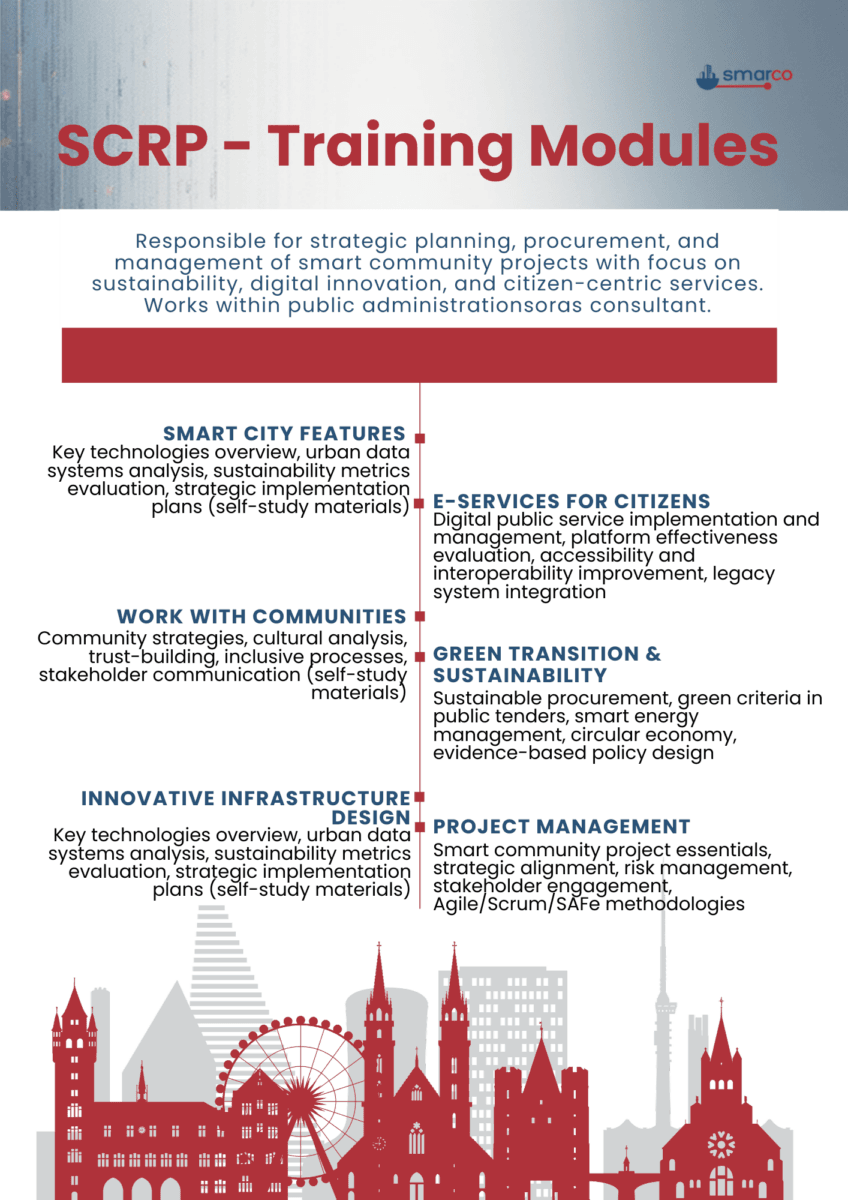
Smart Community Resilient-solutions Procurer/Planner (SCRP)
Smart City Features
Overview of key smart city technologies: analysing urban data systems, evaluating sustainability metrics, assessing environmental impact of urban technologies, and developing strategic implementation plans for smart solutions in urban and rural contexts (materials provided for self-study);
Work with E-Services
Implementation and management of digital public services: evaluating platform effectiveness, integration strategies, analysing user barriers, improving accessibility and interoperability, and integrating with legacy systems;
Work with Communities
Strategies for engaging communities: analysing cultural differences, trust-building techniques, inclusive processes, group dynamics assessment, synthesizing multiple perspectives, and effective stakeholder communication (materials provided for self-study);
Green Transition & Sustainability
Sustainable procurement practices, integrating green criteria in public tenders, managing smart energy sources, circular economy strategies, evidence-based policy design, and monitoring sustainability performance;
Introduction
UNIT 1: Foundations of Smart, Sustainable, and Green Communities
UNIT 2: The European Perspective: Green and Digital Transitions
Innovative Infrastructure Design
Approaches to promoting and procuring innovative, resilient infrastructure: selecting sustainable technologies and materials, adaptive organizational frameworks, integrating digital solutions, and familiarity with digital information and service platforms.
Project Management
Essentials of managing smart community projects: developing project plans aligned with strategic objectives, controlling scope, schedule, and budget, risk management, leading cross-functional teams, stakeholder engagement, and applying Agile/Scrum and SAFe (Scaled Agile Framework) methodologies;